How to Choose a Reputable Bully Breeder: A Buyer's Checklist
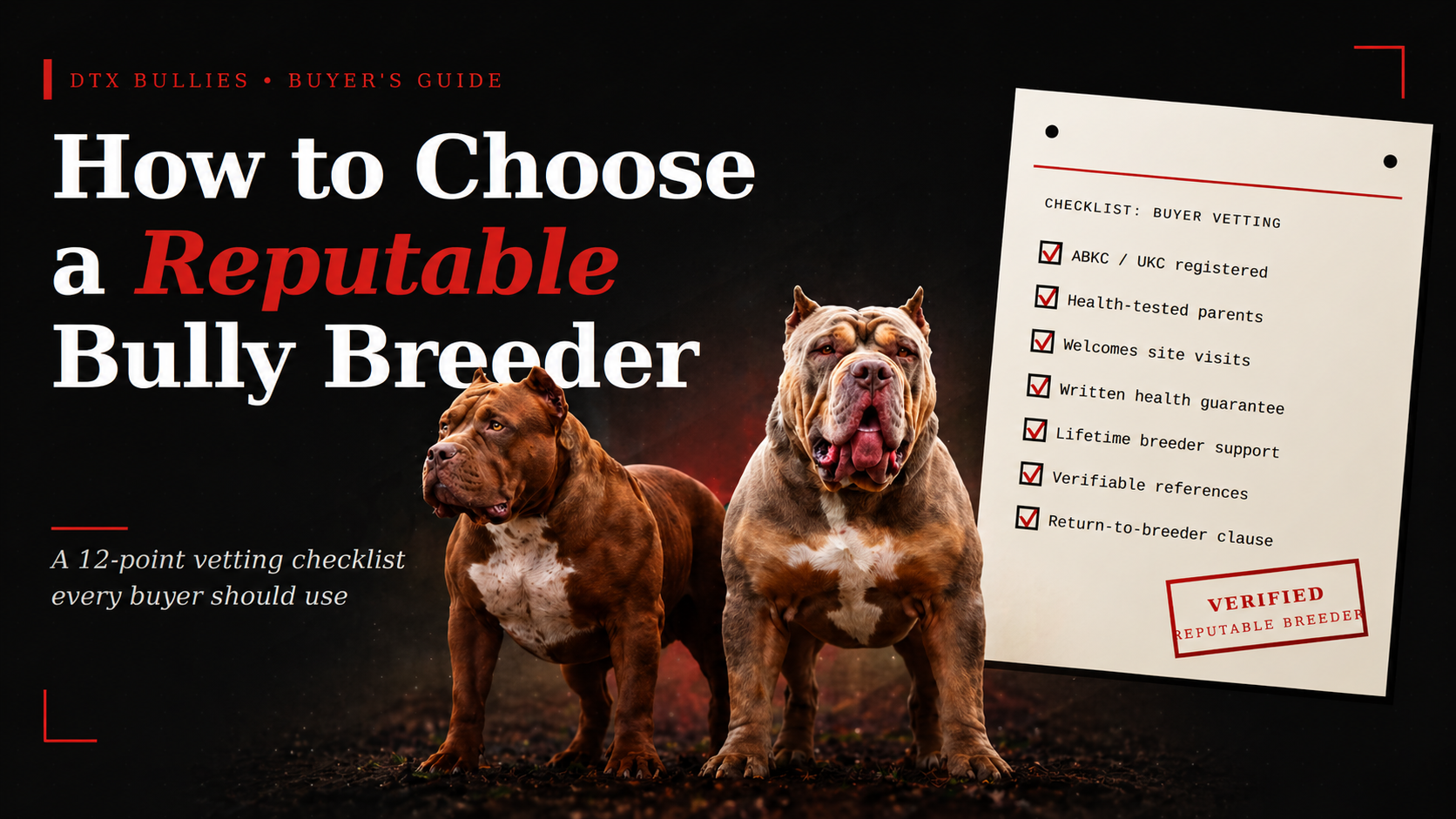
TL;DR: A reputable bully breeder provides ABKC or UKC registration, comprehensive health testing on both parents, an in-person visit to a clean facility, a written health guarantee, lifetime breeder support, and verifiable references. Avoid breeders who pressure quick sales, refuse visits, or sell puppies under 8 weeks old.
The American Bully community has grown rapidly over the last decade, and with that growth has come a flood of breeders ranging from world-class programs to people who threw two dogs in a backyard for a quick payday. For buyers, the difference between these two extremes is the difference between a healthy ten-year companion and an expensive heartbreak.
This guide walks you through exactly how to evaluate a bully breeder, what questions to ask, what red flags to watch for, and what a legitimate breeder relationship looks like.
What Makes a Bully Breeder "Reputable"?
A professional and reputable breeder is someone whose primary motivation is improving the XL bully breed, not just chasing profit. They make breeding decisions based on health, temperament, conformation, and pedigree compatibility, not just on whether two dogs are available and in heat. They invest substantially more in each litter than they recoup, and they stay involved in their puppies' lives long after the sale.
Concretely, a reputable bully breeder will demonstrate every one of the following.
The 12-Point Checklist for Vetting a Bully Breeder
They are registered with ABKC, UKC, or both. American Bullies are not AKC-recognized. The American Bully Kennel Club (ABKC) is the breed's official registry, and the United Kennel Club (UKC) also recognizes the breed. Avoid breeders who only offer "CKC" (Continental Kennel Club) papers, widely considered a paper-mill registry.
They have health-tested both parents. At minimum, you should see OFA hip and elbow evaluations, cardiac clearance, and a DNA panel screening for breed-relevant conditions. Many top programs also do BAER hearing tests and patellar evaluations.
They welcome in-person visits. A breeder who refuses to let you visit, insists on meeting at a parking lot, or only ships sight-unseen is hiding something. Every legitimate breeder will show you their facility and the puppy's parents.
Both parents are on-site or accessible. You should be able to meet the dam at a minimum. If the sire was used through stud service and lives elsewhere, the breeder should provide his registration, photos, health testing, and contact information for his owner.
Puppies are raised inside the home or in a clean, climate-controlled environment. Puppies should never be raised in unventilated outdoor kennels or unsanitary conditions.
They do not release puppies before 8 weeks. The American Veterinary Medical Association and every reputable bully organization consider 8 weeks the absolute minimum, with 9–10 weeks preferred. Breeders who push puppies out at 6 weeks are prioritizing cash flow over puppy welfare.
Puppies come with age-appropriate vaccinations, deworming records, and a vet-issued health certificate. You should receive complete documentation at pickup.
They provide a written health guarantee. Standard guarantees cover congenital and genetic defects for at least one to two years, with clearly defined remedies (replacement puppy, partial refund, etc.).
They have a contract requiring the puppy be returned to them if you ever cannot keep it. This single clause is one of the strongest indicators you are dealing with a real breeder. They genuinely never want one of their dogs to end up in a shelter.
They ask you questions. A good breeder interviews buyers, not just the other way around. Expect questions about your living situation, experience with the breed, family members, other pets, and intentions for the puppy.
They have verifiable references. Ask for contact information for at least two or three previous puppy buyers, and actually call them. Also check Google reviews, Good Dog profile, and Facebook recommendations.
They offer lifetime support. Reputable bully breeders take phone calls about training questions, nutrition, health concerns, and behavior years after the sale. They are invested in the puppy's lifetime success.
Red Flags: Warning Signs of a Backyard Breeder or Flipper
Some signals are immediate dealbreakers. If you encounter any of the following while talking to a breeder, walk away.
Multiple breeds available, or constantly available "designer" mixes. Reputable breeders specialize.
Pricing far below market, or "discounts" for quick decisions and cash payment.
No questions asked about you. A breeder who will sell to anyone with money does not care where their puppies end up.
Refusal to provide health testing documentation, or vague claims like "the parents are healthy" without paperwork.
Pressure to commit immediately with claims of "other interested buyers." Reputable breeders have waitlists, not pressure tactics.
Will only meet at neutral locations or insist on shipping without a visit.
No registration paperwork or only "CKC" papers, which have no relationship to the legitimate American Bully registries.
Photos that look stock or stolen. Reverse-image-search any breeder's puppy photos to verify authenticity.
Requests payment via gift cards, wire transfer, or cryptocurrency. Always pay using a method that offers buyer protection.
Cannot articulate why they bred this specific pairing. A real breeder can talk for thirty minutes about why they chose this dam and this sire.
Questions to Ask a Bully Breeder Before You Commit
Bring this list to your initial conversation with any breeder. Their answers - and their willingness to engage thoughtfully - will tell you everything.
What health testing have you done on both parents? Can I see the documentation?
Can I visit your facility and meet the parents?
What registry are the puppies eligible for, and when do I receive papers?
What is your health guarantee, and what does it cover?
Do you have a return-to-breeder clause in your contract?
How are the puppies socialized between birth and pickup?
At what age do you release puppies, and what vaccinations and deworming will be complete?
Can I speak with two or three of your previous puppy buyers?
Why did you choose to breed this specific pairing?
What support do you offer after I take the puppy home?
Are you a member of any breed clubs or breeder associations?
What food do you feed, and what do you recommend transitioning to?
Where to Find Reputable Bully Breeders
Beyond your own research, several platforms vet breeders before listing them, and can be a good starting point for narrowing your search.
Good Dog: Maintains a screened breeder directory with verified health testing requirements.
ABKC Breeder Directory: Lists registered breeders working within the official American Bully registry.
UKC Breeder Listings: Another path to verifying registry-active breeders.
Local breed clubs: Regional American Bully clubs often maintain breeder referral lists for members in good standing.
Veterinarian referrals: Established vets who treat bully breeds often know which breeders produce healthy, well-tempered dogs.
The Real Cost of Choosing the Wrong Breeder
Buyers who try to save $1,500 by choosing a backyard breeder routinely spend $5,000 to $20,000 over the dog's lifetime addressing preventable issues — chronic skin conditions, hip dysplasia surgeries, cardiac problems, allergy management, and behavioral training for poorly socialized puppies. Beyond the financial cost, the emotional cost of watching a beloved dog suffer from a preventable genetic disease is immeasurable.
A reputable breeder is not a luxury. They are an insurance policy on the next ten to twelve years of your life with this dog.
Ready to Talk to a Breeder You Can Trust?
At DTX Bullies, we welcome the kind of due diligence this article describes - in fact, we encourage it. Health testing documentation, in-person visits, references, and lifetime support are non-negotiable parts of how we run our program. If you are ready to ask the hard questions, we are ready to answer them.
Frequently Asked Questions
-
Most established breeders maintain waitlists ranging from a few months to over a year, depending on the bloodline and what you are looking for. If a breeder always has puppies immediately available, that is itself a question worth asking.
-
It can be, but only after you have done full due diligence; video calls with the breeder, virtual facility tours, complete documentation, and verified references. Always prefer in-person visits when possible.
-
Consider bully-breed rescues in your area. Breed-specific rescue organizations regularly have American Bullies and bully mixes available at a fraction of breeder pricing, and they desperately need homes. Also, breeders like DTX Bullies do have xl bully adoption programs for anyone interested in owning a bully dog for less.