XL American Bully vs Pitbull: Why They're Not the Same Dog.
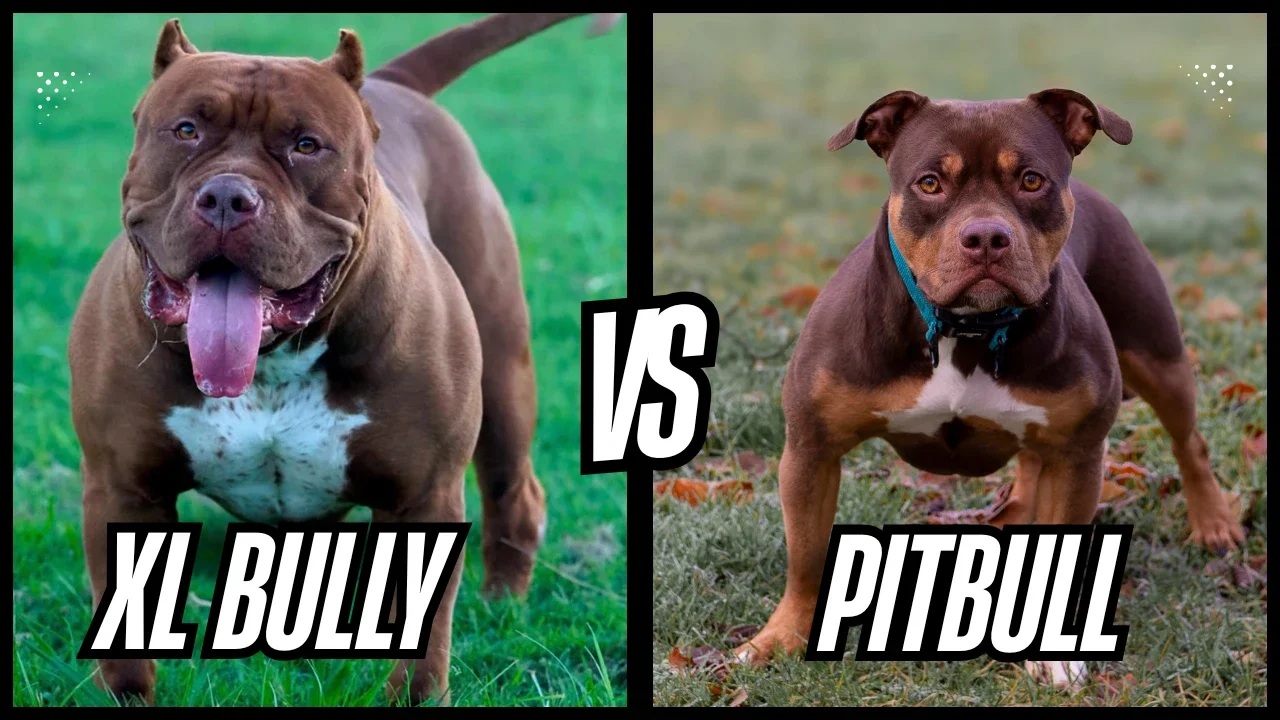
The XL American Bully and the American Pit Bull Terrier are two separate breeds with different histories, different builds, and very different energy levels. The Pitbull is a working terrier bred for athleticism and drive. The XL Bully is a companion breed created in the 1990s specifically to remove that drive while keeping the powerful look.
People mix them up constantly, and it's an understandable mistake. The Bully descends from the Pitbull; they share coat types and colors, and plenty of listings online slap whichever label sells better on whatever dog they're selling. But if you're deciding which dog to bring home, the differences matter a lot more than the similarities.
We breed XL American Bullies here in Dallas, and a good portion of the families who contact us start the conversation with some version of "so is this basically a big Pitbull?" This article is the long answer to that question.
Is an XL American Bully the same as a Pitbull?
No. The XL American Bully is its own breed, recognized by the United Kennel Club in 2013 and by the American Bully Kennel Club since 2004. The American Pit Bull Terrier is a separate, much older breed with its own registry standards. They're related the way a Labrador and a Golden Retriever are related: shared ancestry, different dogs.
The confusion comes from two places. First, the Bully was developed from the Pitbull, so the family resemblance is real. Second, "Pitbull" gets used as a catch-all label for any blocky-headed muscular dog, which lumps together at least four distinct breeds plus countless mixes. When a news story or a shelter listing says "Pitbull," there's often no way to know what dog they're actually describing.
What's the difference between an XL Bully and a Pitbull?
The short version: the XL Bully is roughly twice the weight, wider, shorter in stature relative to its mass, and bred for a calm companion temperament. The Pitbull is lighter, leaner, more athletic, and carries working drive that needs a daily outlet.
Size and build
A male American Pit Bull Terrier typically weighs 35 to 65 pounds. A male XL American Bully starts around 80 pounds and commonly reaches 130 or more. Put them side by side and nobody would call them the same breed. The Bully has a broader chest, heavier bone, a wider skull, and a lower, more muscular stance. The Pitbull is built like the athlete it was bred to be: tucked waist, springy movement, visible conditioning.
Head and body structure
The ABKC standard for the XL Bully calls for a large, blocky head with pronounced cheek muscles and a broad muzzle. The APBT standard describes a medium-length head that's proportionate to a lighter frame. The Bully's front end is noticeably wider, with more distance between the front legs. Once you've seen a few of each, you stop confusing them.
Coat and colors
This is where they genuinely overlap. Both breeds carry short, smooth coats in nearly every color: blue, fawn, black, brindle, tri-color, merle in some lines. Coat tells you almost nothing about which breed you're looking at. Build and papers tell you everything.
Which breed came first, the Pitbull or the American Bully?
The Pitbull came first by well over a century. The American Pit Bull Terrier traces back to 19th-century England, where bulldogs were crossed with terriers to produce game, athletic working dogs. The UKC formally recognized the APBT in 1898. The American Bully didn't exist until the 1990s.
That gap in history explains the gap in temperament. Breeders in the 1990s, mostly in Virginia and Los Angeles, started with APBT foundation stock and crossed in bulldog-type breeds with one goal: keep the muscle and presence, breed out the working intensity. They wanted a family dog that looked formidable and lived like a lapdog. Over about fifteen years of selective breeding, that's what the American Bully became, and the ABKC formalized the standard in 2004 with four size classes. The XL is the largest.
So when people ask why the Bully is calmer than the Pitbull, the honest answer is that calmness was the design brief. It's what the breed was built for.
Do XL American Bullies have a high prey drive?
No. Low prey drive is a defining trait of the breed and a specific requirement of the ABKC standard, which calls for a stable, confident, outgoing temperament with zero tolerance for aggression in the show ring. The working drive that gives the Pitbull its intensity was deliberately bred down over generations.
We see this daily in our own yard. Our adult dogs share space with barn cats. Squirrels cross the fence line and get watched, sometimes followed a few steps, then ignored. Guests' small dogs come through during pickup visits, and the reaction is curiosity and an invitation to play, never a hard stare or a stalk. That's typical of well-bred XL Bullies, and it's one of the traits we select for hardest.
One honest caveat. "Well-bred" is carrying weight in that sentence. Individual dogs vary, and a Bully from a breeder who selected only for size and color, with no attention to temperament, can behave nothing like the standard describes. A dog is what its breeding made it. This is true of every breed, and it's the single biggest reason to be picky about where your puppy comes from.
Are XL Bullies calmer than Pitbulls?
Yes, in general, and by a wide margin. The typical XL Bully needs a solid daily walk and some play, then spends the rest of the day within arm's reach of its people. The typical Pitbull needs real, structured exercise every day and will find its own projects if it doesn't get it.
Here's what that looks like in practice. It's 7 pm on a Tuesday. You worked late, you're tired, and the walk was shorter than usual. The Bully has spent most of the evening on the cool tile, gets up to follow you to the kitchen, and settles again. A young Pitbull in the same situation is pacing, bringing you toys, and eyeing the couch cushions. Neither dog is misbehaving. One of them just has fuel left in the tank, because it was bred to have fuel in the tank.
Pitbull people love that energy, and for an active owner it's a feature. Runners, hikers, and sport-dog handlers get a tireless partner. But if your household is more Netflix than trailhead, that same energy becomes a management problem, and the dog pays for it as much as you do.
Which is better for families, an XL Bully or a Pitbull?
For most first-time owners and busy families, the XL Bully is the easier fit. Its lower energy and people-focused temperament mean fewer demands on your time and less that can go sideways. The Pitbull suits active, experienced owners who can commit to daily exercise and structured training.
Neither answer is a knock on the other breed. A well-bred APBT with an owner who meets its needs is a wonderful family dog, affectionate and famously good with people. The problem shows up when the dog's needs and the family's lifestyle don't match.
A lot of the people who call us wanted "a Pitbull look" and then, once we talk through their actual week, realize what they wanted was the presence and the loyalty without the working-line intensity. That dog exists. It's the XL Bully, and it's the entire reason the breed was created.
Why do XL Bullies have a bad reputation?
Two reasons: the UK ban, and the flood of poorly bred dogs sold under the XL Bully label. In 2023 the UK added the XL Bully to its banned breeds list after a series of serious incidents. In the US, the breed remains legal everywhere, though some cities and insurers restrict it.
It's worth being straight about this rather than pretending the headlines don't exist. The breed's popularity exploded fast, and demand attracted breeders who selected for maximum size and intimidating looks, sometimes crossing back to working lines, with zero regard for stability. Many of the dogs behind the worst incidents came out of exactly that pipeline: no health testing, no temperament selection, no registry oversight. They wore the XL Bully label because the label sold.
A dog bred to the actual standard, from parents you can meet, with documented temperament in the bloodline, is a different animal. That's why we tell every buyer the same thing: the breed name on the ad protects you far less than the breeder behind it.
How do I know if a dog is an XL Bully or a Pitbull?
Check the papers first, then the build. An XL Bully will be registered with the ABKC or UKC as an American Bully, with a height classification on the pedigree. An APBT will carry UKC or ADBA registration as an American Pit Bull Terrier. No papers means you're guessing.
Without papers, build is your best clue. A dog pushing past 80 pounds with a wide chest, heavy bone, and a massive blocky head is almost certainly Bully-bred; the APBT standard tops out around 60-65 pounds and penalizes excessive bulk. Ask the seller which registry the parents are in. A legitimate breeder answers instantly. Hesitation on that question tells you what you need to know.
FAQs
-
Usually yes, with proper introductions and supervision, especially if raised together or matched as opposite sexes. Both breeds can carry same-sex dog selectivity, so individual temperament matters more than breed. A responsible breeder or trainer can help you assess a specific pairing.
-
No US state bans the XL Bully. Some cities have breed-specific ordinances that may sweep in bully breeds, and some home insurers restrict them, so check your local ordinances and your policy before committing. Texas law prohibits breed-specific bans at the local level.
-
A well-bred XL Bully from health-tested parents typically costs $2,500 to $10,000, depending on the bloodline. Well-bred APBTs generally range from $800 to $3,000. Prices far below those ranges usually signal a breeder cutting corners on health testing, socialization, or both.
-
About the same. Both carry short single coats that shed lightly year-round with small seasonal bumps. A weekly rubber-brush session keeps either breed's coat in check. Neither is hypoallergenic.
-
Yes, for owners who understand the size. A well-bred XL Bully's calm, people-focused temperament makes it one of the most forgiving large breeds for first-timers, provided you commit to early training and socialization. At the same time, the dog is still small enough to manage easily.
Still weighing the two breeds for your own home? Read our full guide comparing the XL American Bully against six other large breeds, or reach out and tell us about your household. We're happy to talk you out of one of our dogs if it's the wrong fit. Every dog we place is a dog we want to stay placed.